
London, 28 September 1839. The first number of The Medical Times introduces itself with a prominent masthead and three closely set columns. At the left of the page, the heading Our Intentions places the publication’s purpose before its readers. The date and issue number anchor this edition in a specific document, rather than a general image of nineteenth-century medicine. [S06] [S08]
The opening statement identifies a gap between the number of medical readers and the circulation of existing journals. It presents the new newspaper as an attempt to reach an audience not adequately served. That is an editorial proposition as much as a commercial one: a publication must decide not only what it knows, but whom it is able to reach. [S08]
For a contemporary reader, this is the page’s most interesting starting point. Access is not separate from editorial purpose. The choice of audience influences what needs explaining, which discussions deserve space and what kind of relationship a journal establishes with its readers. Those are questions to bring to the document, not answers to assume from its age.
The physical page rewards attention too. Its title, introductory statement and neighbouring columns can be seen together. Reading a facsimile lets the eye move between them without losing the arrangement in which the original reader encountered them. Our commentary accompanies that view rather than replacing it.
Historical Medical Press brings this way of looking into Aesthetic Times. Alongside current reporting on beauty, science and culture, the series opens a different reading room: one in which the presentation of medical knowledge becomes a subject in its own right.
Begin with the masthead. Locate the date. Read the editor’s stated intention. Then ask how the page gives that intention a visible form. The pleasure of the archive lies in that close encounter with a publication making its case to a reader.
This feature is contemporary commentary, not a complete transcription or translation of the historical statement.
View the opening page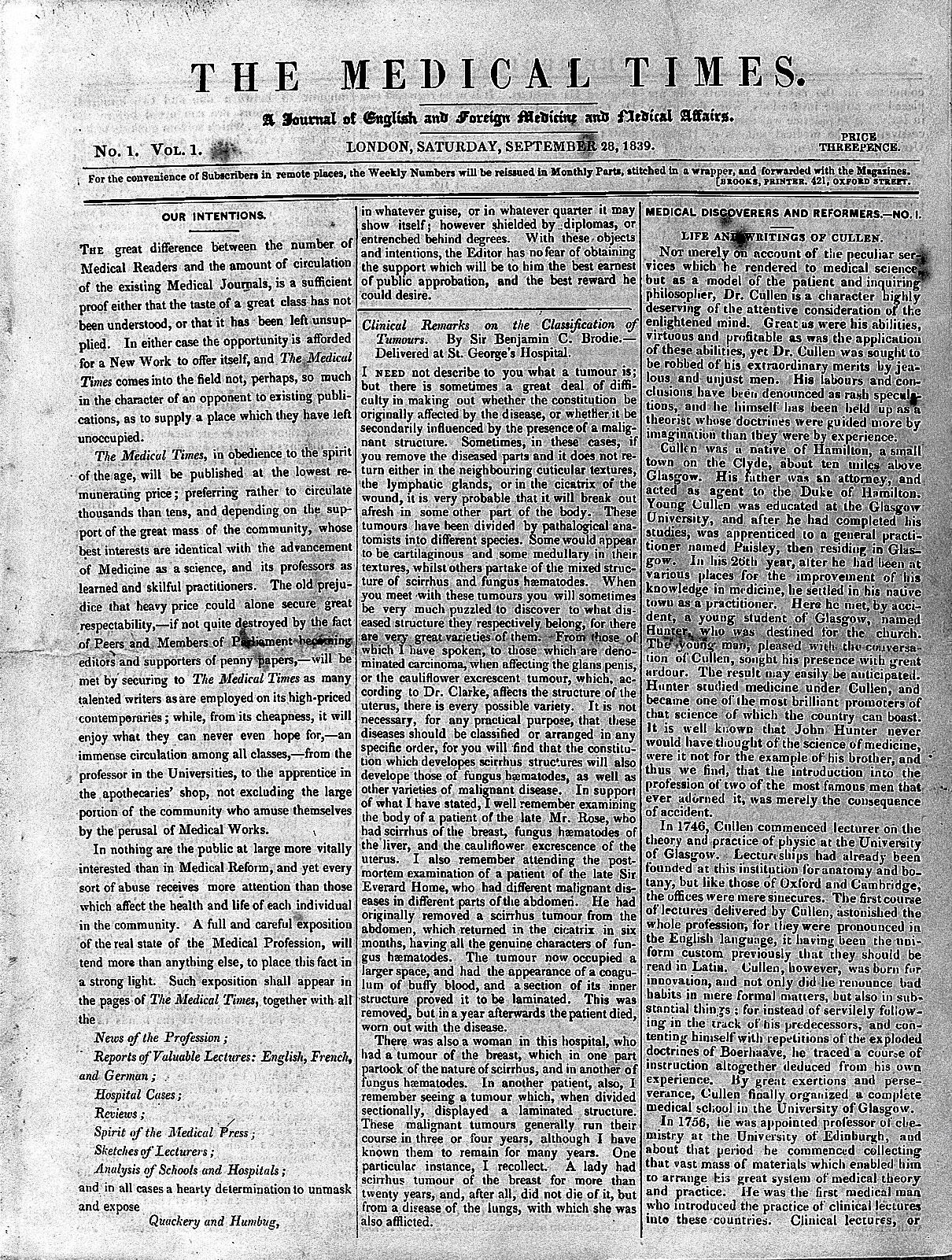
![[S08]](https://iiif.wellcomecollection.org/image/L0025025/full/full/0/default.jpg)